
The SaaSpocalypse, Reframed: How AI Is redefining Software value in Cost Management
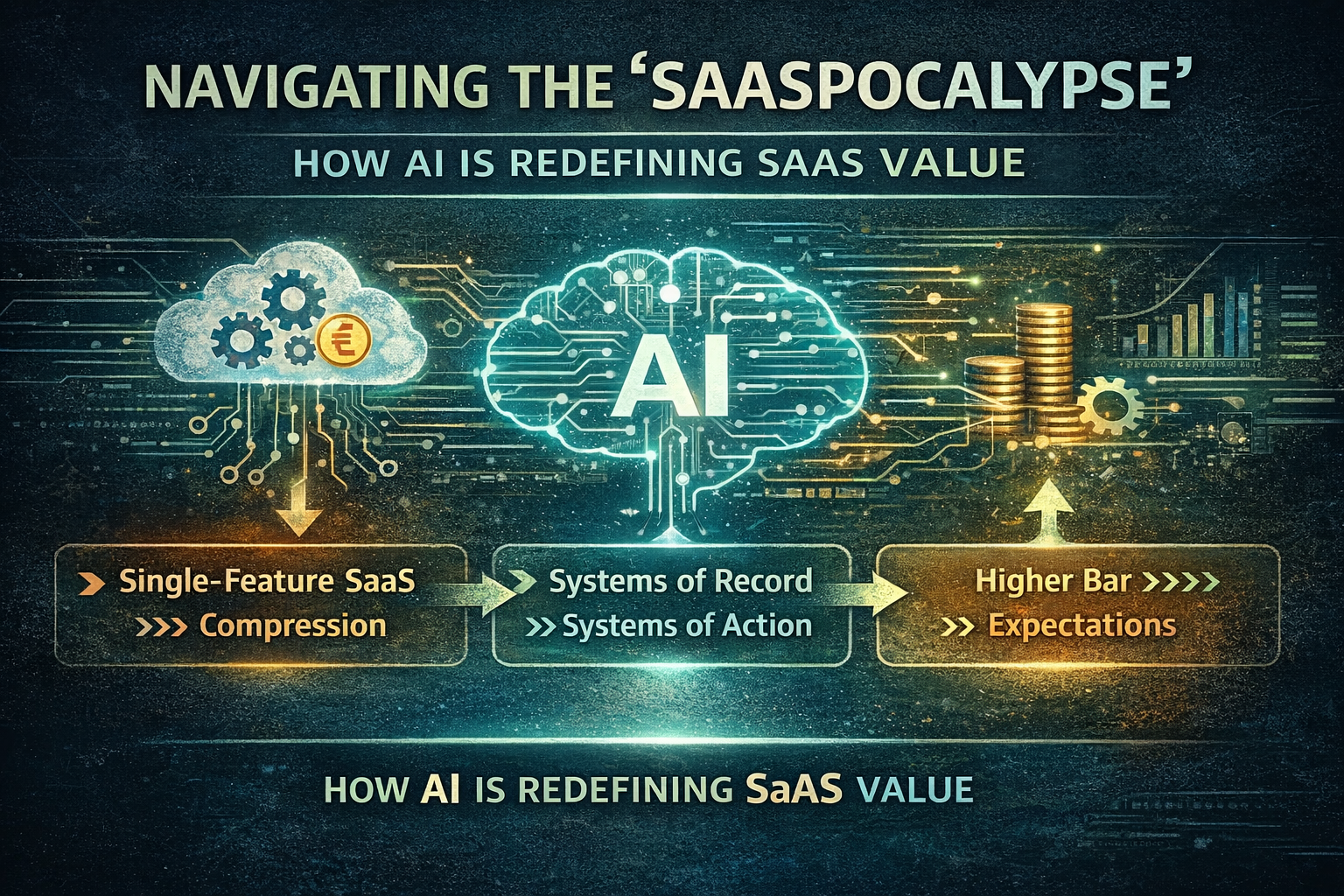
Over the past year, a new term has started to circulate with increasing frequency: the “SaaSpocalypse.”
It’s usually framed in dramatic terms — AI is coming for software companies, compressing margins, eroding pricing power, and fundamentally undermining traditional SaaS revenue models.
Like most market narratives, it contains a kernel of truth. But it also misses the more important story.
AI is not killing SaaS.
What it is doing is forcing a reset - not just in how software is built or sold, but in how value is defined, measured, and justified. Nowhere is this more visible than in cost management, where expectations around transparency, impact, and outcomes are changing rapidly.
This blog explores three structural shifts that sit beneath the “SaaSpocalypse” conversation - and why they matter for enterprise buyers, software vendors, and cost management leaders alike.
1. The Compression of Single-Feature SaaS Value
For much of the last decade, SaaS growth was fuelled by specialisation.
Point solutions flourished by doing one thing extremely well:
- A specific workflow
- A specific report
- A specific optimisation
This model worked because building software was expensive, integration was hard, and switching costs were high.
AI changes that equation.
Large language models and AI-native platforms dramatically lower the cost of recreating narrow functionality. Capabilities that once justified an entire product can now be embedded into broader platforms, layered into existing tools, or accessed directly through GPT-powered applications.
The implication is not that these capabilities lose their usefulness — but that their standalone value is compressed.
For buyers, this manifests as a simple question:
“Why am I paying for a separate tool to do this?”
For vendors, it raises a harder one:
“What value do we deliver beyond this feature?”
In cost management, this pressure is already visible. Tools that surface a single metric or generate periodic insights struggle to justify their footprint when similar outputs can be produced faster, more flexibly, and at lower marginal cost through AI-enabled approaches.
The takeaway is not that SaaS is dying — but that shallow value is being rapidly absorbed by AI.
2. From Systems of Record to Systems of Action
Historically, enterprise software has largely operated as a system of record.
Its role was to:
- Capture data
- Structure information
- Support human decision-making
In this model, value was delivered indirectly. Software provided visibility, while people provided judgement and action.
AI is fundamentally changing this division of labour.
As machine intelligence becomes more capable, expectations shift from:
“Show me the data”
to:
“Tell me what to do — and help me do it.”
Modern platforms are increasingly expected to:
- Recommend actions
- Surface trade-offs
- Optimise continuously
- Intervene proactively
This marks a transition from systems that inform decisions to systems that drive outcomes.
In cost management, this shift is particularly pronounced. Static dashboards and periodic reviews are poorly suited to environments where software estates change daily, consumption fluctuates constantly, and risk accumulates invisibly.
AI-enabled cost management platforms can move beyond reporting to:
- Identify inefficiencies in real time
- Flag emerging technical debt early
- Recommend corrective action before costs escalate
Software that remains passive — regardless of how sophisticated its reporting — risks becoming background infrastructure rather than strategic capability.
3. The Permanent Raising of the SaaS Value Bar
Perhaps the most consequential effect of AI is not what it replaces, but what it resets.
AI changes buyer expectations around:
- Speed to value
- Depth of insight
- Ongoing relevance
- Demonstrable impact
In practical terms, this means organisations are becoming far more precise about what software actually delivers — and far less tolerant of unused capability.
This is not a temporary correction.
Once buyers experience software that continuously adapts, recommends, and optimises, the tolerance for tools that merely exist declines rapidly.
In cost management, this shows up clearly:
- Software spend is under increased scrutiny
- Utilisation matters more than licence counts
- Value must be continuously earned, not periodically defended
Importantly, this scrutiny does not signal that software is less important. It signals the opposite.
Software is now expected to carry more responsibility — and justify its place with measurable outcomes.
What This Means for Cost Management
The “SaaSpocalypse” narrative often focuses on vendor revenue. The more meaningful shift is happening on the buyer side.
AI enables enterprises to understand their software estates with a level of clarity that was previously impractical. Hidden spend becomes visible. Redundant capability becomes obvious. Technical debt surfaces earlier.
As a result, cost management evolves:
- From reactive clean-ups to continuous optimisation
- From manual reviews to intelligent automation
- From intuition-driven decisions to data-led trade-offs
This raises the bar for cost management platforms as well. Delivering visibility is no longer enough. The expectation is action, guidance, and measurable impact.
Not a Collapse — A Recalibration
The language of collapse makes for compelling headlines. It obscures what is actually happening.
The SaaS market is not imploding. It is recalibrating.
AI compresses low-level value while expanding expectations at the top end. It challenges narrow differentiation while rewarding platforms that integrate insight, action, and outcomes.
For software vendors, this demands a clear answer to a harder question:
“What value do we deliver that cannot be easily absorbed elsewhere?”
For enterprises, it presents an opportunity:
To manage cost with greater intelligence, precision, and confidence than ever before.
In cost management, especially, the winners will not be those that simply surface information — but those that help organisations act on it, continuously.
The SaaSpocalypse isn’t about the end of software.
It’s about the beginning of a new definition of value.
